
3-tones coloured lensesAn iris that looks like it was born with you.
A limbal ring and two shaded colours rebuild a real iris, layer upon layer. The definitive answer for those with dark eyes.
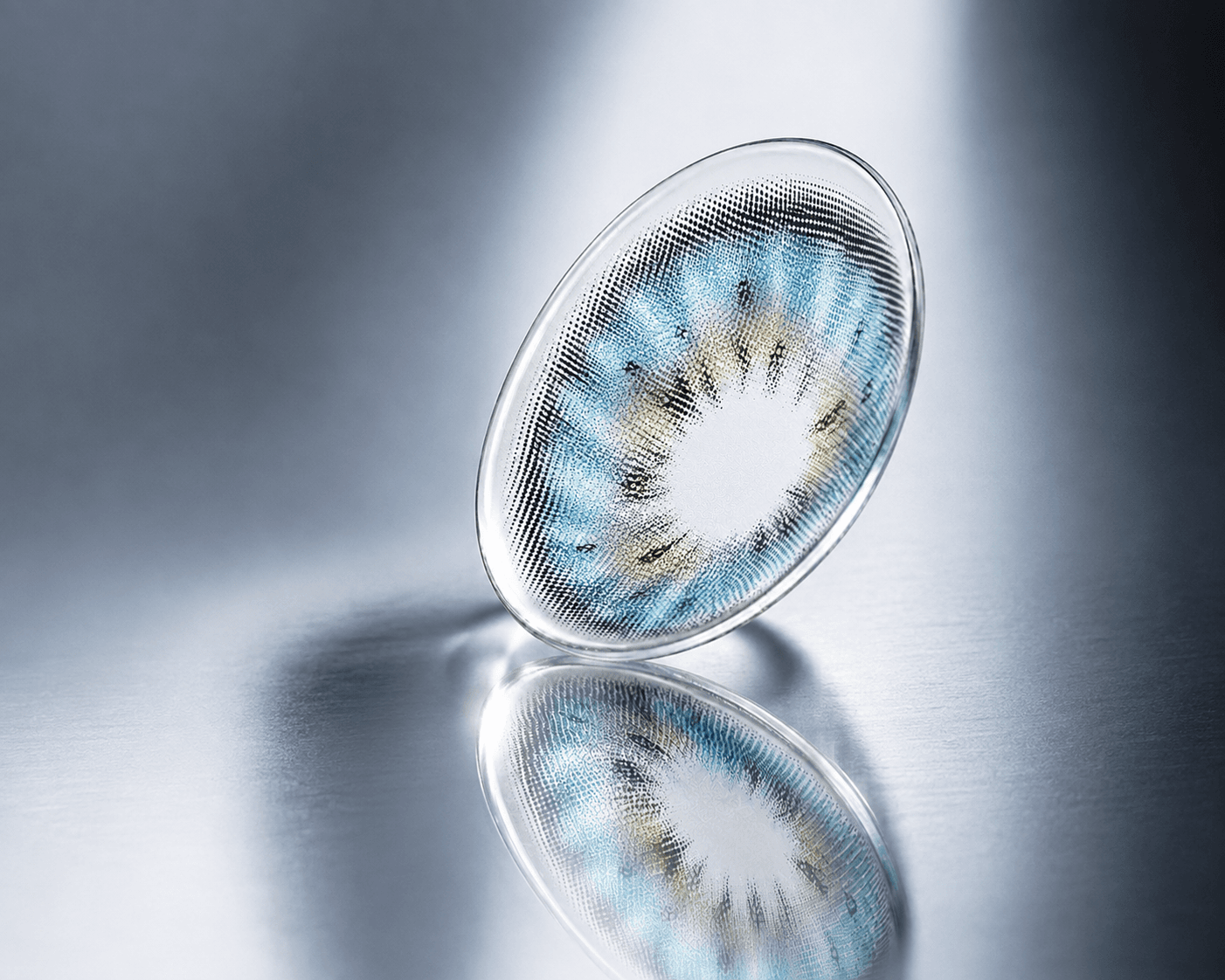
What "3 tones" means in a coloured lens
A 3-tones lens layers three levels of design: the dark limbal ring on the outer edge, the main colour over the iris area and a second inner shade, blending towards the pupil zone, which stays, as always, clear and transparent.
The reference is a phenomenon that exists in nature: central heterochromia, that iris which shades from one outer colour into a different inner one, green turning to amber, blue warming into hazel around the pupil. It is the structure that makes an iris look "real" to the person looking at it: not a colour, but a depth. The Desìo 3-tones collections start from here.
The best coloured lenses for dark eyes? The ones built in layers
Anyone with a dark brown or almost black iris has experienced it: most coloured lenses "disappear" on dark eyes, or cover them with a flat, artificial, doll-like effect. The problem is not the colour: it is the construction.
A single tint laid over a dark iris loses brightness and depth. The three layers of the 3-tones design solve both problems: the opaque pigments completely cover the starting colour, and the inner shading rebuilds a new iris over the existing one, complete with outline, dominant colour and variations around the pupil. The result holds up to close inspection and to daylight.
That is why, to the question "which coloured lenses are covering but natural for dark eyes", the manufacturer's technical answer is: the 3-tones ones.
And on light eyes?
3 tones allow a total colour change, from ice to hazel, from green to grey, while keeping the naturalness that a solid colour alone would not give. The inner shading breaks up the uniformity of the pigment, and the eye never has that "painted" look that gives away a low-quality lens.
Who it is the right choice for
For those who want to really change, and not let it be known. The 3-tones lens is for those with a dark iris who want believable green or grey eyes at thirty centimetres; for those who work with their own image, in front of a camera or an audience; for those who have tried flat coloured lenses and been disappointed.
Anyone looking only for a more intense outline on their own colour can stop at the 2-tones lenses; anyone who wants the invisible touch-up of the colour they already have will find the right measure in 1 tone.
Also with prescription, also for high myopia
The 3-tones collections are available with prescription: the daily version covers a wide power range including high myopia, where elsewhere only plano lenses are found. Colour and correction in a single lens.
For the professional
3 tones is the argument for winning back the most sceptical segment of the Italian market: the wearer with a dark iris convinced that cosmetic lenses are not for them. The in-store demo is the decisive tool, the effect on a dark brown iris is immediate and, unlike the flat lenses the customer may have tried online, it stands up to the mirror test at thirty centimetres.
The double daily/quarterly format follows the same consultation logic as 2 tones: dailies for occasional use and a first experience, quarterlies for the loyal wearer.
One training point for the sales counter: many customers ask for "the most natural" when they mean the most discreet. It is worth distinguishing: the most discreet is 1 tone; the most realistic, the one that best mimics a real iris, is 3 tones. These are two different requests served by two different products.
The Qualimed 3-tones collections
- Attitude 3 Tones, four shades built on central heterochromia: Irresistible Blue, Precious Grey, Charming Green, Tender Hazel. In a daily or quarterly format.
- Timeless, the timeless interpretation in four colours: Eternal Brown, Timeless Grey, Infinity Blue, Forever Green. In a monthly format.
In brief: 3 tones at a glance
| 1 tone | 2 tones | 3 tones | |
|---|---|---|---|
| Colour layers | 1 single tint | limbal ring + 1 colour | limbal ring + 2 colours |
| Effect | the most discreet and uniform | defined, intense gaze | the deepest and most natural |
| Ideal on | light eyes; dark eyes for a soft effect | light and dark eyes | dark eyes; maximum realism |
| Replacement | monthly | Daily, monthly or quarterly | Daily, monthly or quarterly |
Frequently asked questions
Which coloured lenses cover dark eyes?
The 3-tones ones: the three layers of opaque pigment completely cover even the darkest irises, rebuilding a new iris on top with outline and natural shading.
What is central heterochromia?
A natural iris with two colours: one on the outside and a different one around the pupil. It is the model the 3-tones design draws on, and the reason why these lenses look like real eyes.
Does the intense colour interfere with vision?
No: the central zone of the lens, over the pupil, is always free of pigment. The colour covers only the iris area.
Are there prescription versions for high myopia?
Yes: the daily 3-tones version covers high myopia too. Your optical store can check the availability of your power.